3 things:
1. A painfully shy woman of Austrian descent comes to work unpaid for the eminent chemist Otto Hahn in Berlin's Kaiser Wilhelm Institute in 1912. The two collaborate for over thirty years studying radioactivity, despite her exile from a Nazi Germany because she was a Jew. Her insight is key in the discovery of the phenomenon of nuclear fission. In 1945, the Nobel Prize in Chemistry is awarded to Hahn, while she isn't heard of.
2. In 1951, a woman begins working as a research assistant in the biophysics unit of King's College, London where she uses her expertise in X-Ray diffraction techniques to study DNA. She exposes herself to over 100 hours of radiations (a fact that led to her death from ovarian cancer in 1958) and finally manages to obtain one 'Photograph 51' which is critical in helping James Watson and Francis Crick correctly identify the double helical structure of DNA (the photograph was disclosed to them by a colleague of the woman, without her permission). In 1962, the Royal Swedish Academy of Sciences awards Watson and Crick the Nobel Prize in Medicine, while she is conveniently forgotten.
3. A bright and talented woman works on her thesis in Radio Astronomy at the University of Cambridge. On the particularly chilly morning of 21 December 1967, she finds four equally spaced "blips" or pulses in her data, thereby confirming the existence of neutron stars called pulsars, a feat regarded by many as one of the most fascinating discoveries in astronomy in the 20th century. For her contributions, Antony Hewish shares the 1974 Nobel Prize in Physics with one other.
These women are Lise Meitner, Rosalind Franklin and Jocelyn Bell Burnell and I did not name them above purposely.
I have always dismissed things like gender inequality because in my mind, even acknowledging that women are considered inferior to men by many in our society, lent some credibility to the notion. Reading the stories of these three women (especially Jocelyn Burnell who is still alive) made me rethink all that.
For me the idea of gender inequality is so ridiculous I didn't even see the need of listening to the people who didn't share this opinion (or as I considered it, fact). But maybe that isn't always helpful. Like the thing we did with Donald Trump. The idea of his presidency was so insane to even consider, that we forgot to dismiss it. And here he is now winning state after state.
So as painful as this might be, maybe sometimes we do need to stand up for our opinions that we consider to be natural truths. Because the other side might consider theirs that, too.
1. A painfully shy woman of Austrian descent comes to work unpaid for the eminent chemist Otto Hahn in Berlin's Kaiser Wilhelm Institute in 1912. The two collaborate for over thirty years studying radioactivity, despite her exile from a Nazi Germany because she was a Jew. Her insight is key in the discovery of the phenomenon of nuclear fission. In 1945, the Nobel Prize in Chemistry is awarded to Hahn, while she isn't heard of.
2. In 1951, a woman begins working as a research assistant in the biophysics unit of King's College, London where she uses her expertise in X-Ray diffraction techniques to study DNA. She exposes herself to over 100 hours of radiations (a fact that led to her death from ovarian cancer in 1958) and finally manages to obtain one 'Photograph 51' which is critical in helping James Watson and Francis Crick correctly identify the double helical structure of DNA (the photograph was disclosed to them by a colleague of the woman, without her permission). In 1962, the Royal Swedish Academy of Sciences awards Watson and Crick the Nobel Prize in Medicine, while she is conveniently forgotten.
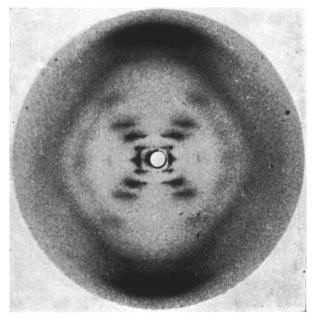 |
| Photograph 51 |
3. A bright and talented woman works on her thesis in Radio Astronomy at the University of Cambridge. On the particularly chilly morning of 21 December 1967, she finds four equally spaced "blips" or pulses in her data, thereby confirming the existence of neutron stars called pulsars, a feat regarded by many as one of the most fascinating discoveries in astronomy in the 20th century. For her contributions, Antony Hewish shares the 1974 Nobel Prize in Physics with one other.
These women are Lise Meitner, Rosalind Franklin and Jocelyn Bell Burnell and I did not name them above purposely.
I have always dismissed things like gender inequality because in my mind, even acknowledging that women are considered inferior to men by many in our society, lent some credibility to the notion. Reading the stories of these three women (especially Jocelyn Burnell who is still alive) made me rethink all that.
For me the idea of gender inequality is so ridiculous I didn't even see the need of listening to the people who didn't share this opinion (or as I considered it, fact). But maybe that isn't always helpful. Like the thing we did with Donald Trump. The idea of his presidency was so insane to even consider, that we forgot to dismiss it. And here he is now winning state after state.
So as painful as this might be, maybe sometimes we do need to stand up for our opinions that we consider to be natural truths. Because the other side might consider theirs that, too.

No comments:
Post a Comment